Thursday, August 11, 2011

Is Africa Scary?

"Is Africa scary?" my niece asked me recently.

I was visiting my home country, the United States, for a few weeks, and had been trying to persuade her to visit me in Accra.

Given the bad-news reputation of the continent - wars, pirates, dictators, famine, mosquitoes and disease - it was a fair question.  I was quaking in my boots myself, I'll admit, the first time I boarded an airplane bound for that large land mass across the Atlantic.

But this week I've been thinking about a different question: Are the US and the UK scary?  And I've had to answer: Um, yes.

With the US still recovering from a greed-driven recession, narrowly enduring a debt crisis seemingly created by self-interested politicians, and now watching its financial markets in a fearful free-fall, it does seem like a scary place.  And with disparity of wealth in the States on the rise, how long until resentment over the riches of others helps drive a major societal uprising?  Frightful stuff.

Ghana, by contrast - where poverty can be much more in-your-face and yet the fear of violence and crime is much lower than in some US neighborhoods, where the economy appears to be booming - seems a positively refreshing and stable place.

Riotous looting in the streets of Accra?  Nope.  Just a regular day
in the always-busy downtown market district.
Then there are, of course, the nights-on-end of hooliganism that have plagued the UK this week.  The photos and footage of burning buildings, looted stores, and rampaging rioters has been shocking.  Especially given the high standards of 'civilisation' that we expect from one of the leading countries of 'the West.'

In an ironic twist, an international friendly football (that's soccer for you who have your head under a US sports pillow) match between Ghana and Nigeria on Wednesday night had to be canceled because of the riots.  Why, you ask?  Because it was slated to be played at a stadium in London.  Duh.

Barring comment on why a sports event between two African nations was scheduled to be played in England (I'm sure there are good reasons…), isn't it sweetly and satirically wry - for anyone who is a fan of the African continent - that a stadium in Accra or Lagos would have been a safer place for this match to take place?

Who's the scary now, huh?  (Poke in the English-man's ribs.)  Huh?

The colonized don't often get to outshine the colonizer, but as a former subject nation of England, all of Ghana should be reveling (in a humble and sorrowful-for-the-violence way, of course) in this turn-around.  Ghanaians who have lived abroad often come back home and complain about the relative disorganization of traffic, government bureaucracy, and other parts of public life here.  But what are they thinking now?  "Hey, thank God I'm back on the safe and sane continent."

There's not much scarier than mobs of internet-coordinated hooligans converging to do violence wherever they please, apparently motivated by little more than a thirst for destruction and theft.  Africa has had its share of child soldiers in the battlefield bush, but at least they were coerced into the hard life.  In the UK, this latest life-of-crime drama seems to be a free and personal choice by the criminals, a lark.  Mob violence as adrenaline.  (See this Daily Telegraph writer's article on how a good-sized segment of the looters appear to be white-and-well-to-do, not stereotypically minority-and-poor.)

"Is Africa scary?" my niece asked me, voicing a sort of primal American fear of the 'dark' continent.

"No," I said.  And then, with a wink:  "Not unless you're afraid of black people."

My niece, who has an African-American father, glanced down at her own brown skin.

"Oh," I could see her thinking.  "Right."

Suddenly, Africa seems the place to be.

Tuesday, August 2, 2011

Christmas in (almost) July

I thought that, in the middle of the summer months, it might be nice to have a reminder of the Christmas time of year; thus, this post.

This past December, a friend of mine showed me a 2 liter bottle of Coke he had bought in Accra.  Locally produced for the madhouse Christmas-market season, the plastic bottle's wrapper-graphics featured a black Santa with curly white hair and beard holding out a bottle of Coke in front of Independence Arch, Ghana's iconic monument to colonialism's end.

We were delighted with this bit of local kitsch, and set about figuring out how to use the bottle in a photo shoot.  I came up with the idea of trying to recreate that wrapper-graphics Santa scene with a street-found 'model,' like this:


You'll notice I gave up on asking someone to wear the Santa suit and beard.  But I think the hat gets the general idea across.


When I showed up at the arch around Christmas-time, camera gear dangling, I was immediately met by a short-ish, grizzled, middle-aged Ghanaian guy who claimed to be the arch's 'caretaker.'  He said he'd have to prevent me from taking any photos of the arch unless I got government permission.  But I simply stayed on course, setting up my tripod and taking a few test shots, all the while engaging him in conversation.  And, by the end of it, he was agreeing to be my first subject.


After that there was a line of 'models' waiting to hold the Coke bottle up in front of my lens, as passersby - and some local refuse collection professionals - got into the Santa spirit.


Now, if I can just meet someone from Coke's advertising department, I can sell them their Christmas 2012 ad campaign idea.

Thursday, June 23, 2011

Of Camera-Phones and Long Climbs

It's not long ago that I bought my first cell phone with a camera in it.  It took me years to catch up to the mobile phone revolution, but now that there's smart-phones everywhere, even in Ghana, I figured it was time for me to leave basic behind.  If my friend can hold up his iPhone in a bar and have it tell him what song is playing, now I can finally at least take (very bad) photos wherever I go.

By coincidence, not long after purchasing this world-expanding piece of technology (I can instantly email photos of Accra's street-curiosities to all my friends?!), I did an overnight bicycle ride to a town about 90 kilometers (55 miles) from the city.

Koforidua is somewhat famous for its Thursday local-bead market, and is a base for visits to nearby waterfalls.  I, however, had already visited the waterfalls and wasn't too interested in the beads.  I just wanted somewhere to pedal to.  And, I knew the route led me through some nice hills.

Having never met a hill I didn't like, after squeezing through the crush of market-town Medina I enjoyed the my first-day climb up to the town of Aburi.  But I enjoyed even more the climb the next day, on my way back from Koforidua to Accra, a nice 35-minute pull, oft-steep, up to the hill town of Mamfe.

On this trip, I re-learned what my cousin Glen Lapp taught me - that, no matter how painful the end of the ride was the previous day, it's always good to get back on the bike in the morning.  By the time I made that climb up into Mamfe, having been on the bike for around 3 hours and 38 kilometers (about 23 miles), I was feeling better than when I had woken up that morning.

Biking = joy.  Well, some of the time.

Cameras can equal joy, too, even if they're the really bad ones Nokia crams into their mobiles.  And so, at the risk of seeming self-obsessed (isn't that what blogs are about?), I'm posting some camera-phone self-portraits I took of myself along the way to Koforidua.

Getting out of Accra.

Contemplating whether to ride, or get a ride,
up that hill behind me.

At the top of the hill:
why is it always so hot in Ghana?

In Koforidua.

Friday, May 20, 2011

For Developing Countries, a New Way to Read

On a Saturday morning not long ago I rode in a bus with some high school students out to a village about an hour beyond Accra, accompanying them on an outreach project.  From different parts of Asia, Europe, Africa, and America, they all attended a local international school with a strong emphasis on service.

We were going to the small town of Adeiso, site of a pilot project by the non-profit Worldreader organization.  Worldreader wants to improve literacy in developing countries by getting Kindle and other e-reader devices into the hands of local students, and they've started in Ghana.  The international students I bussed in with were coming to read with Ghanaian students, helping the local kids with reading vocabulary and comprehension while using their Worldreader-provided Kindles.

Beyond the immediate wow-factor of placing such a cool technology in the hands of a kid who might not even have electricity in the house, there's some obvious benefits here.  There's no costly and time-consuming shipping of physical books.  Students can choose books they want - a vast variety greater than any shipping container could hold - and download them through the local cell phone network.  The appeal of the technology and the ready availability of hundreds of volumes in one small package gets kids quickly hooked on the idea of reading for learning and for fun.

There's downsides, too, of course.  What about that student with no electricity at home, how will she charge her e-reader?  Won't the dust and the everyday hazards of village life be too much for a 'fragile' piece of technology?  What happens when a kid drops their Kindle and the screen breaks?  Will students be engaged for a moment then forget about their e-reader, or have it stolen, or try to sell it on the local market for cash?

Worldreader's thought of these problems, and more, and are coming up with solutions as they seek to expand their program beyond an initial two sites in Ghana.  And I have to say, for a school like the one I saw in Adeiso - where there was zero printed material lying around in the classrooms and no evidence of a bookshelf anywhere - the immediate delivery of a neatly packaged, hand-held library seems like a pretty revolutionary thing.

When I walked into the Adeiso classroom, the international school students were sitting on one side of the room.  The local students sat on the other, clutching their Kindles.  Soon, though, the two groups had paired up on the school's wooden benches, filling the room with the sweet sounds of reading.


In an ironic technological turn, it was the Ghanaian students - whose previous experience with electronics has likely been limited to a cell phone - who showed the international kids how to use the Kindle.  The international school kids all have laptops and iPods, but few had ever used an e-reader before.

And in another turn, as they sat and read mainly Ghanaian folk tales together, the international school kids found that the local students were teaching things to them just as much as learning from them: how to pronounce unfamiliar names in the local stories, some phrases of the local language Twi.

The local students also taught the international ones some of their popular hand-clapping games.


As one high schooler pointed out to me later, the Ghanaian kids seemed to base their play on physical, body-related things like hand-clapping or football (soccer), which don't need any of the sophisticated sports equipment or video consoles the more wealthy international school students are used to.


Our trip finished up with a walk around the village, with the visiting students getting a peek at a much different life from then one they live in their relatively fancy Accra homes.  I hope it was a good learning experience on all sides.

And I hope that Worldreader can find ways to successfully get kids in Ghana, and other less-developed countries, to read and keep reading.


Thursday, May 12, 2011

Abstracts - Lighting

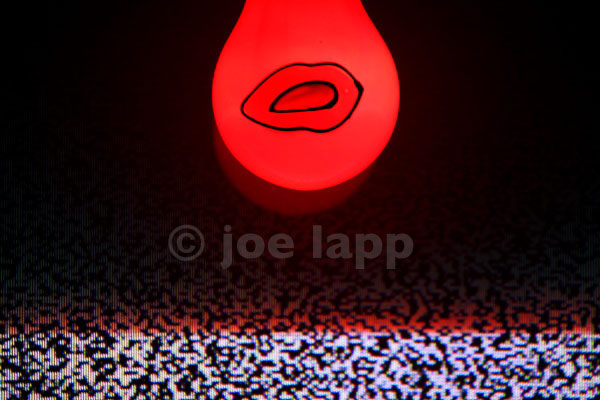
There's some other camera buffs here in Accra that I sometimes trade photos with.  A couple months ago we challenged each other to work with lighting in new or challenging ways.  I ended up getting into some creative abstract work, which turned out to be a lot of fun.  Here's a few of the results.


This is a specialty light bulb (red with orange lips painted onto it) that I lit and hung in front of a TV with nothing but static showing on its screen.  You can see the static-grain, frozen in time.  The screen is partially blanked-out because I sped my shutter up enough to outpace the little 'gun' that scans back and forth shooting electrons or whatever-the-heck-they-are onto the back of the screen to make up the image that we see.


This one is the same red bulb hung in front of the same static-flooded TV screen, but in fuzzy focus.  I also manually turned the white balance way down to get the cold, blue tones.  For this one, I fired a flash to create the ghostly white blob, which is the flash's reflection in the TV glass.


These fuzzy-focused red and green dots are the little off/on lights on my satellite TV decoder.  You can make out the edge-lines of the satellite box and the top of the TV, where the box sits (they're slanty, since I tilted the camera over a bit on my ball-top tripod).  The white blob is, again, a fired flash bouncing off the front of the TV.  This shot required a bit of physical juggling, as I had to turn my satellite box off/on in the middle of the shot (around a 5 second exposure) to get both the red and green off/on lights into the same frame.

This was my first time working hard with a more abstract concept, and the first that I've put fuzzy-focus to good use.  I might be addicted.

Saturday, April 30, 2011

Farida Bedwei: Definition of a Miracle

Born in Nigeria and growing up in Grenada and the U.K., Farida Bedwei moved to Ghana with her family in the late 1980s.  Developing cerebral palsy as an infant, she has achieved to become a top software engineer in Ghana, and now an author.

Her first book is a novel, Definition of a Miracle.  Precocious girl-child Zaara, on her family's move from England to Ghana, has to deal with life in a society where her cerebral palsy is not understood.

I went to a reading Farida gave at the end of February at the Goethe Institute in Accra, a frequent sponsor of arts-focused events.  The evening was hosted by Ghana-based writer Nana Nyarko Boateng, whose Writers Project of Ghana is promoting creative writing and authors in and around Accra.

I offered to shoot some photos of the event, and here are a few of the results.

Nana introduces Farida.

Farida reading.

A smile for a successful event.

You can buy her book on Amazon.

Thursday, April 21, 2011

Burundi's Biking Bananas!

This little video of mine - about cargo bikers in the tiny African country of Burundi - debuted at the April 2011 Filmed By Bike weekend, a Portland, Oregon festival dedicated to short films about bikes and bike culture.

Check it out, it's zany and banana-licious.


I'm totally excited that I can call myself an independent filmmaker!

And now at least you know where Burundi is.

Many thanks to my friend, Mike Vogel, for cluing me in to the Filmed By Bike tradition and for kicking my butt enough to put something together for it.  Check out his own film, "Right Hook," which was nominated for the best-video award.  It's a hilarious take on what many bikers wish they could do to inconsiderate drivers.

Thanks for watching.  And, if you liked, do share.