Wednesday, July 18, 2012

A French Tour in 60 African Seconds

I'm watching the Tour de France bicycle race, on TV, in Ghana.  

Today's breakaway group - a small number of riders who have established themselves some minutes ahead of the peloton, the main body of riders - is nearing the top of the famous Col du Tourmalet.

http://www.letour.fr/indexTDF_us.html

I want to be riding in mountains like that.  Real ones of course, not the electronic beige ones of the official race ticker.  Though I have trouble, these days, simply keeping my pace up on an hour-long, relatively flat pedal.

These days, this is the best I get for hills.

The climb to Aburi, north of Accra.

As I watch the Tour I'm waiting for something to happen.  For some rider to attack.  For someone to take a corner too fast and end up in the bushes.  Any kind of drama.

The Tour unfolds so slowly in real time on TV... even on the crucial and race-deciding mountain stages.  But if you can wait long enough to catch the decisive moments - an unmatched acceleration, a brutal crash, a solo rider just staying ahead of the peloton in the last 500 meters to cross the day's finish line first - the wait can be worth it.

Last night I saw on Facebook this photo:

http://www.facebook.com/Every60Seconds

I think this is hilarious, and exactly the kind of satire needed against the prevailing knee-jerk disinformation of 'Africa's' backwardness.  Nothing but conflict and starving children?  Hardly.

There's an African rider in this year's Tour de France, actually.  White, of course, and from South Africa.  But hey - South Africa is still part of the continent last time I checked.  Go Africa.

I'm writing this sort of disconnected, stream-of-consciousness post partly because I'm distracted by keeping part of my attention on the bikers on TV.  And partly because, in the larger sense, I'm 'distracted' these days by my baby care duties.  My son is nearing half a year old, now, and my stay-at-home-dad status has got my blog-post frequency way down.  But I don't mind that too much.

I like it that my son is growing up in Africa, where every 60 seconds a minute passes.  Though unfortunately I won't be riding him on my bicycle any time soon, here.  Between the taxis that come much too close to my wheels and the open ditches waiting beside narrow city roads, I won't take the risk.

I can't wait to teach him to ride, though.  And show him the fun of satire.  Maybe I'll even get him to see a Tour de France some day, in person.

For now, some little guy named Voeckler is pedaling at breakneck speed down a French mountain after leaving all his competition behind on a long day of racing that included four very hard hills.  And an African-born rider is dragging the leader of the Tour up over the last climb of the day and back onto the wheel of his chief competitor, the African-born pedaler himself in second position overall in the race.

For me, I'll enjoy my next 60 seconds in Africa.

Friday, June 8, 2012

Urban Beach, Urban Beauty

Seeking beauty in an urban environment has always something disconcerting; in Accra this means also overcoming the blatant lack of urban planning, the problematic concept of "public space" and the problems of everyday filth and hygiene.  To find beauty where it is most hidden is the artist's most daring assignment...

The vocation of the arts is in the desire to expose people to beautiful things, but the arts are selfish: in general we expect the people to come to the arts rather than the arts going to the people.  Integrating museum art and street art into one overall event allows to bring the best of both worlds together...

          -Rudek van der Helm, from thebeautyfulones.com site


I read Ghanaian author Ayi Kwei Armah's novel The Beautyful Ones Are Not Yet Born back in my twenties when I, naively, thought I might go to Africa on a Fulbright exchange.

Then, Ghana seemed an exotic place - unable to be understood, out of reach.  Now I live here.

Six months ago I picked up a copy of the book and started to read it again.  Figured I might have a different perspective these days.  But my reading got waylaid.

I was brought back to the book last week by a group of artists who are using the novel's title and themes as a springboard for an art exhibit and happening - sharing their own perspectives on Accra life.  Anna Kurtycz and Rudek van der Helm of Studio Kurtycz, whose November/December 2011 show Neither Black Nor White I also blogged about, teamed with local artists to put together this group event.

The performance-burning of one of a local artist's installations.
While I haven't yet seen the gallery portion of the show hung at the Goethe Institut in Accra, I did get to attend an art affair that opened the companion open-air/installation portion of the show in the tiny urban fishing community of La on the edge of Accra's beachfront.

When I arrived at the event a few musicians and dancers were beginning a procession through the community's winding dirt paths.  Along the way they passed artist's photos hung on the concrete or plywood walls of village structures as well as numerous site-specific installations.


The most accessible and engaging of the installations that I saw were Rudek's larger-than-life, block-print-style portraits painted onto clear acrylic sheets and scattered around the community.  Done in black with a sparing accent color or two where appropriate, I slowly came to realize these were portraits of La residents.

Looking at a portrait titled "John Wayne," a man came up to me and proudly told me I was regarding a picture of himself.  Turns out he is the chief fisherman of the village, and I was standing outside his house; the print was mounted just by his front door.


Apparently the chief fisherman loves Westerns, and so everyone knows him as John Wayne.  His portrait carried a boat paddle and a fishing net instead of the obligatory cowboy lasso and six-shooter.

The "moving installation" of artists and La residents wearing "I (Heart) LA" t-shirts was another perfectly whimsical touch.  Were the shirts originally 'I Love Los Angeles' tees appropriated for the moment?  Were they designed and made to be Ghana-La shirts?  I still don't know, but either way they were an invitation to contemplate the vast difference between the Los Angeles metropolis and Ghana's urban beach village of La, as well as a playful comment on the appropriation/appropriateness of tourist kitsch.

Anna and Rudek's careful alliances with Ghanaian artists - and now a Ghanaian community as well - treated audience members on Saturday to a Western-style public-art display integrated into and complementary of the life of a ramshackle developing-country settlement.

Rudek's print-painting (left) of a common Accra sight  - a man with his pants half down peeing -
echoed by a human in the distance fastening his pants after some business on the beach.  Though an
unhygienic practice, the lack of access to toilets is also a justice issue.
"It's hard to tell where the art ends and the village begins," said art appreciator and audience member Laura Evans.

I felt that way, too, as I joined two middle-aged local men atop a lopsided pile of concrete blocks to get a better perspective on the crowd, the performers, and the art.  I watched local kids kick a dirty soccer ball between contemporary-art-inspired installations that would have been just as at home in the Tate Modern in London as on this hardscrabble dirt field next to the tight clusters of village huts.  I watched a small group of women stoking their open-air kitchen fires, stirring large metal pots of soup, tending to their children - as they always do - listening to the live music and regarding the art-audience-outsiders with appreciation and amusement.


And I felt that, at least for this day in the dirty urban-beach town of La, ordinary life was an artistic enterprise and art became a reflection - perhaps even an illumination - of both the mundanity and the sanctity of the everyday.

Now I'd better get back to finishing that Beautyful Ones book.

A Zoomlion (refuse collection) worker's portrait mounted by the dumpsters
where she sorts her garbage, just across a dirt field from her hamlet of La.

Thursday, December 8, 2011

In Ghana, Bikes Going 'Green'

It's been surprising to find, over the last year, that Ghana is becoming a center for the manufacture of bamboo bicycles.

Wait, did that just say bamboo bicycles?!

Yup.

You mean real bicycles, that you can actually pedal, out of bamboo?

Absolutely.

That's kind of what went through my head, anyway, when I stumbled across the bamboo idea.

I had no notion you could build a bicycle frame from the plant.  Or that bamboo bikes had been catching on, in the US and Europe at least, with the environmentally-conscious and hipster crowds.  But when I Googled "bikes in Ghana" sometime after moving here, there they were: bamboo bikes.

Wow.

A couple months ago I got serious about reading up on these uber-cool pedaling machines.  Googling for more info, I found out that Craig Calfee - originator of the carbon-fiber bicycle and one of the first people to build a modern bamboo bike - was working with independent bamboo bike builders in Ghana and would be visiting soon.

Wait, no, he's in Ghana now.  Could I possibly meet up with him?

Why yes, after a flurry of phone calls and emails to track him down, I could.  Sweet.

Craig works with local builder Wisdom Toxla to test a frame.

I caught up with him at the bike shop his nonprofit Bamboosero organization runs in Accra.  Craig and Bamboosero support small, independent builders to make high-quality bamboo frames for export from Ghana to the US, where they justly command a price few Ghanaians are able or willing to pay.

Wisdom Toxla is Bamboosero's main bicycle builder in Ghana.  Once a Ghana national road cycling champion, he lives to make things.  As a teenager, he built a wooden bicycle that ended up in the local science museum as a model of home-grown engineering.  Now, he's turned to bamboo.

Since Craig introduced me to Wisdom at the Bamboosero shop, I've gone back to him twice to take advantage of his bike mechanic skills and hear more of his story.

Wisdom truing a wheel in Accra's Bamboosero bike shop.

I've also visited another Bamboosero shop, stopping in the town of Abompe on my recent bike trip from Accra to Kumasi, Ghana's second city and cultural capital.  Local builder Peasah took the time to meet with me on a Saturday afternoon in the hot season, giving me a tour of his bike workshop before pedaling off into the heat on his own bamboo wheels for a delayed meeting with a friend.

Peasah and his bamboo ride.

If you're in Ghana, or want to call up the Calfee Design workshop near Santa Cruz, CA, these 'green' and Made-in-Africa bikes are available for sale.  They're beautiful, with polished bamboo tubes fading into the organic, plant-fiber joints that hold everything together.

And, they perform well.  Reviewers much more technical than I say bamboo frames exhibit damping action as good as or better than carbon fiber, creating a great ride.

Another player in Ghana's bamboo bike scene is Bamboo Bikes Limited.  Financed by Ghanaian businessman Kwame Sarpong and with motivation and help from the Bamboo Bike Project at Columbia University's Earth Institute, this factory is aiming for full-scale production of low-cost bamboo bikes.   They hope their two-wheelers end up in the small towns and rural areas of Ghana and West Africa, providing affordable, locally-made transport empowerment to under-developed communities.

Factory builders ride samples of their work.

Part of my idea for biking to Kumasi was to visit this factory just outside the city.  I found their workers are fully trained and ready to put some bikes together.  After a delay in getting bike components into the country, they are presently swinging into full production mode, hoping to crank out hundreds of bicycles a year.

Beyond the obvious wow-factor of the bamboo bikes themselves, you know what's cool in all of this?  That Ghana, a nation on the supposedly struggling continent of Africa, is becoming known for a very contemporary and environmentally-leading technology.

I applaud.

Friday, December 2, 2011

A Home for Art

I've always dreamed of having a nice house with an open lawn, creating some art, then turning the place into a gallery for my work.

Here in Accra, Parisian-trained expatriate artists Anna Kurtycz and Rudek van der Helm are living that dream. 

And not only that, they're doing one better, using their current show "Neither Black Nor White" to showcase the work of a select few Ghanaian artists as well.

Working under the artistic brand of "Studio Kurtycz," Anna and Rudek have shared their display space with local artists Isaac Konney, Kelvin Haizel, and Nii Obodai to run an exhibit from this past Wednesday, November 30 to Saturday, December 3.

I dropped in on the show's opening on Wednesday and absolutely loved what I found: a medley of engaging installations, photographs, video work, paintings, woodcuts, and prints all tucked fondly into well-crafted spaces around a manicured garden, a pool, and a few outbuildings.

Rudek told me they gave particular thought, for this show, to the use of lighting in shaping discrete and welcoming exhibit-spaces for the nighttime open-houses.  Their care and attention paid off: it's a magical night garden of lovingly-created, well-displayed, quality artworks.

A ghostly Rudek installation haunts the pool.


In a screened terrace, photos by Nii Obodai make inspired use of white space and blur to channel the harmony and devotion of a unique Accra-based community of Moslems and Christians.


Vibrant butterfly paintings by Kelvin Haizel float through a pool-side pavilion.


Beautifully-layered photographs of Accra's striking clothing store mannequins show off Anna's artistic city-wanderings.


And ethereal charcoal drawings by Isaac Konney celebrate the beauty-in-the-ordinary that is everywhere in this sweaty, gritty city.


There's even a participatory painting hung on the swingset, with visitors invited to 'paint' a Rudek self-portrait by hitting it with thrown 'eggs' of red dye.


An intriguing body of work.  A cool feast, in this hot season, for the eyes and the mind.

The show is on for two more days.  You can visit, according to the Studio Kurtycz website:

-today, Friday evening, from 6 to 9 pm
-or tomorrow, Saturday evening, from 4 to 8 pm.

Find their studio in Ringway Estate near Ako Adjei interchange, behind the Canadian High Commission and across from the SSNIT guest house.

Thursday, December 1, 2011

Pedaling to Kumasi

Kumasi - Ghana's 'second city' and its cultural capital - lies a few hundred kilometers north and west of Accra.  It has a sprawling open-air market, an Indian restaurant sometimes claimed to be the best in West Africa, a railway station that's been unused for quite awhile, and the joking-est tro-tro conductors around.

Crowds in Kumasi's market.

How do I know all this?  Three weeks ago, I rode my bicycle there from Accra.

Which makes me a legend to some.  "You pedaled all the way to Kumasi!  Are you crazy?  I flew there."

To others, I've fallen a bit short.  "Why yes, I remember that Accra-Kumasi stretch from my cross-continental bike tour back in the late nineties…"  (Ok, no one's said that to me yet, but I expect it to happen one day.)

For myself, it's a mixed picture: I sat my butt on that bike seat for three full days, and I made it.  But I took the VIP bus home.


This was the first real bike touring I'd done since riding across the US with my cousin Glen back in 2002.  Sure I did some out-and-back overnights here in Ghana, but this was to be a multi-day outing with some real distance to cover.  I'd have to buckle down.

And I did.  Sort of.

Day 1: 85 kilometers through hills from Accra to Koforidua.  Day 2: 110 kilometers from Koforidua to Nkawkaw, with a stop at the bamboo bike workshop in Abompe (more about that in a later post).  Day 3: 85 kilometers from Nkawkaw to a friend's house on the edge of Kumasi city.  And then another day of 30 or 40 kilometers riding around Kumasi and finally settling at a hotel in its downtown.

In a way, there's not much to report from all those kilometers.  I got on the road each morning for three days straight and pedaled until I thought it wise to stop - for a cold drink, or for lunch, or for the mid-afternoon break when all living and moving things should be shaded from the relentless tropical sun.

(And that sun was merciless.  From 11 am onwards my overriding thought became: how far can I go this time until I have to break for some shade and some cold liquid.)

To me, bike touring is all about being on the bike.  When I'm not on the bike, frankly, I get bored.  One of the most exciting things about traveling with my new rear rack and saddlebags was that I had enough cargo space to carry a book.  Something to keep my mind occupied when I wasn't in motion.

When I was in motion there were always little things to notice.  The man riding a bicycle with a plastic chair over his handlebars.  The orange-headed lizard who raced me (and won) up the hill to Aburi.  The laborer in a dirty yellow T-shirt laying down his machete to buy plastic packets of gin to spike his afternoon.  Water so cold vapor poured out the top of my bike bottle as I filled it.  A woman in an outdoor shower calling "Hello!" to me as I rode past, her chocolate shoulders dripping with soapsuds.  The "Only Jesus In Stock" store.  In cocoa-farm country, a whole town smelling like cocoa powder.

And, some more substantial memories.

-The joy of the early morning cool.  It was a struggle for me, a natural night owl, to get up and on the road as early as I should have.  In Ghana, the sun rises every day right around 6, and the wise bike tourer is pedaling by then, getting in the miles before the noon-day sun begins to addle the brain.  I usually managed to have my butt in the saddle by 7.  Which left me about an hour to enjoy any sort of morning coolness left in the air.  And boy, did I learn to savor that hour.

-The joy of a cold packet of Fan Ice soft serve ice cream on a hot day.  'Nuff said.


-Getting spanked by a teenage girl outside Mamfe.  Yes, spanked.  I was zipping downhill from Mamfe town and saw some kids horsing around on the road ahead.  They turned out to be teenage girls, who scattered to the side as I passed.  They yelled and laughed at me, as teenage girls will at sights less strange than a white man in biking gear whizzing through African hills.  And, as I glided past, one of them reached out with a stick and tapped me lightly on the butt.  Admirable aim.

-The marching band of Asankare.  Video below.


-Bowls of rice and beans with the chickens.  Restaurant kitchens can be quite slow in Ghana, and so I often turned to the side-of-the-road, under-the-tree, pot-over-charcoal-fire sort of eating establishments to get fuel for my legs.  You stop, the woman dishes out some rice and beans, you're eating.  Done.  These rice-and-bean moments were some of the best of my trip.  The beans were tasty, and I could just sit on the offered wooden bench and watch the street-life around me as hens scratched in the dirt under the plastic table and little yellow chickies ran across my shoes.


-The man who bought me my first Malta.  This was in a road-side bar called the "Hollywood Spot."  Which bore no resemblance at all to Hollywood.  But the man was kind, and called out to me as I sat sweating at a table, waiting for a drink.  "The sun is too hot for you!" he joked to me, but then was suitably impressed when he realized it was a bicycle and not a motorcycle I was riding to Kumasi.  He bought me a Guiness Malta, a sort of non-alcoholic version of Guiness beer.  I don't usually like these dark, malted drinks, but this one tasted sweet and thick and I downed it.


-Craggy hills and peaceful sunset at Nkawkaw.  A line of green hills had been on my right all day after I hit the main Kumasi-Accra road at the Bunso rest-stop junction.  Around Nkawkaw, as the sun set, they became particularly craggy and picturesque.  Maybe I'll get to bike into them one day.


For now, I'll have to just bike into the sunset. 


Tuesday, November 22, 2011

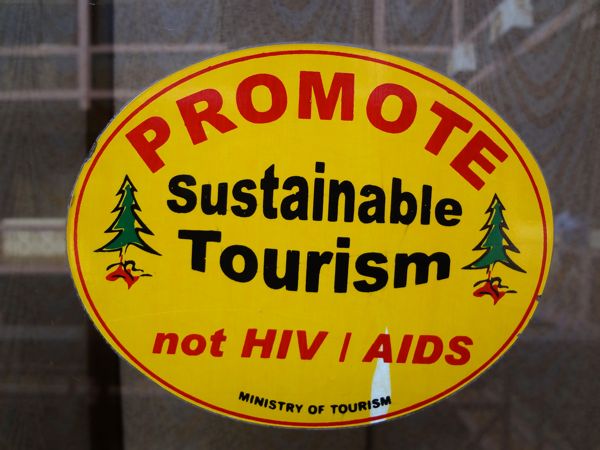
This Should Bring in the Tourists...

A little sticker-gem from the hotel in Kumasi that I stayed in after my bike ride to Ghana's second city.


Check back soon for more about that ride, including my successful search for Ghana's bamboo bike manufacturers.